top of page

What Is Expense Ratio and How It May Impact Your Portfolio

  • Feb 9
  • 3 min read

Understanding the Expense Ratio


An expense ratio represents the annual operating cost of a mutual fund or exchange-traded fund (ETF). It is expressed as a percentage of the fund’s total assets and reflects the cost of managing and operating the investment.


Rather than being billed directly to investors, the expense ratio is typically deducted from the fund’s assets on an ongoing basis. As a result, it is reflected indirectly in the fund’s performance and net asset value (NAV). Understanding this concept is an important part of evaluating investment costs and long-term portfolio efficiency.

A workspace featuring a laptop displaying financial charts and graphs, a smartphone, notebook, and a coffee cup, with text 'WHAT IS EXPENSE RATIO'.


What an Expense Ratio Includes


The expense ratio bundles several operational costs into a single figure. While the specific components vary by fund, common elements include:


  • Management fees: Compensation for portfolio managers and research teams

  • Administrative expenses: Accounting, legal, recordkeeping, and reporting costs

  • Marketing and distribution fees (12b-1 fees): Costs related to advertising and distribution, when applicable

  • Other operating expenses: Custody, compliance, and fund administration


These costs are necessary to operate the fund but reduce the portion of returns that ultimately accrue to investors.


How Expense Ratios Are Applied


Expense ratios are typically deducted daily from fund assets. Because of this structure, investors do not see a separate line-item charge on account statements. Instead, the fee reduces the fund’s total return over time.


Even relatively small percentage differences may influence long-term outcomes, particularly for investors with longer time horizons.


The Concept of Fee Drag


Fee drag refers to the cumulative effect that ongoing investment expenses may have on portfolio growth. Since expense ratios reduce the amount of capital that remains invested, they can also reduce the amount available to compound over time.


While a difference of a few tenths of a percent may appear minimal in a single year, the impact can become more noticeable over decades due to compounding.


Expense Ratios and Compounding


Compounding works on net returns, not gross returns. This means that expenses are deducted before gains can compound. Over long periods, higher expense ratios may materially reduce the ending value of a portfolio compared to similar investments with lower costs.


This does not imply that lower-cost funds are always preferable, but it highlights the importance of evaluating costs in context.
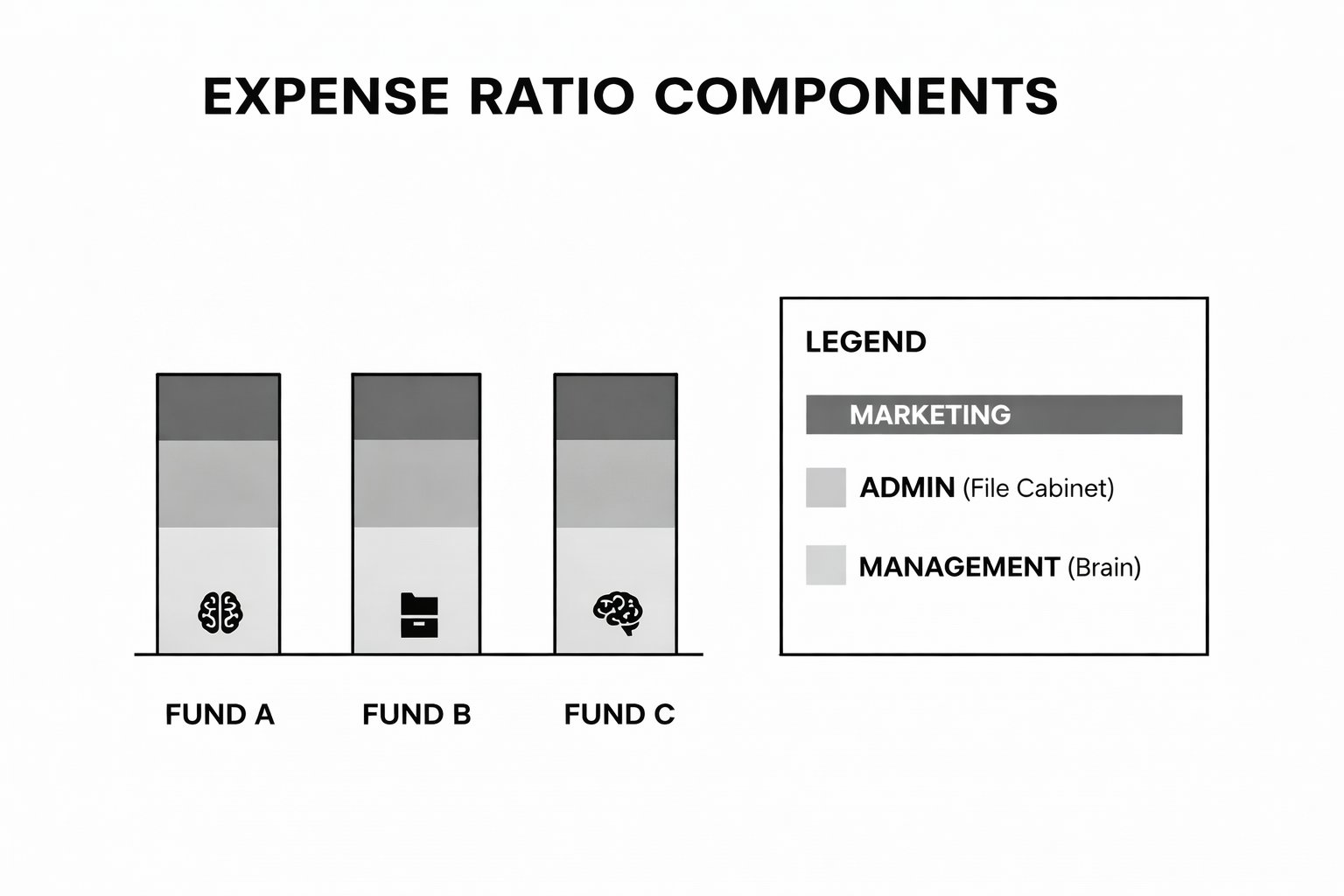

Stacked bar charts illustrate expense ratio components like Marketing, Admin, and Management for three funds.


Comparing Expense Ratios Across Investment Types


Expense ratios often vary based on investment strategy and structure.


  • Actively managed funds: Typically have higher expense ratios due to research, trading activity, and management oversight

  • Passively managed funds (index funds): Generally have lower expense ratios because they track a benchmark rather than rely on active security selection

  • ETFs: Often have lower operating costs, though this varies by strategy and asset class


Comparing funds within the same category may provide more meaningful insights than comparing across different strategies.


What Expense Ratios Do Not Include


Certain costs are not reflected in a fund’s expense ratio, including:


  • Brokerage commissions from trading within the fund

  • Sales loads or transaction fees charged by brokers

  • Account-level fees charged by custodians or platforms


Understanding the full cost structure of an investment involves reviewing more than just the expense ratio.


Evaluating Expense Ratios in Context


An expense ratio should be evaluated alongside other factors, such as:


  • Investment strategy and objectives

  • Risk profile and asset class exposure

  • Historical performance relative to benchmarks (net of fees)

  • Role of the investment within a broader portfolio


Cost is an important variable, but it is one component of a comprehensive investment evaluation process.


Stacks of coins with a plant symbolizing financial growth, next to glasses and a binder, and 'COST-EFFICIENT PORTFOLIO' text.


Conclusion


An expense ratio represents the ongoing cost of owning a fund and directly affects net investment returns. While the impact may not be immediately visible, these costs can influence long-term outcomes through compounding.


Understanding how expense ratios work and how they fit within an overall investment strategy can help investors make more informed, cost-aware decisions aligned with long-term financial goals.


Investment advice offered through Stratos Wealth Partners, Ltd., a registered investment advisor. Stratos Wealth Partners, Ltd and Parkview Partners Capital Management are separate entities. Neither Stratos nor Parkview Partners Capital Management provides legal or tax advice. Please consult legal or tax professionals for specific information regarding your individual situation. Investing involves risk, including possible loss of principal. The information presented is for educational purposes only and should not be interpreted as individualized investment, tax, or legal advice. Past performance is not indicative of future results. For more information, please review our Form ADV, available upon request.


Comments


Financial Advisor, Investment Advisor, High Net Worth, Wealth Management, Tax Planning, Risk Management, Financial Coordination, Retirement Planning, Charitable Giving, Columbus Ohio, Parkview Partners Capital Management

291 East Livingston Ave.
Columbus, OH 43215


Phone: (614) 427-2132

Fax: (614) 427-2132

  • LinkedIn

FORM CRS


Privacy Policy

Investment advisory services are offered through Stratos Wealth Partners, Ltd., a Registered Investment Advisor located in Beachwood, Ohio. [www.stratoswealthpartners.com]. 

Parkview Partners Capital Management offers its financial services through Stratos Wealth Partners, Ltd., (“Stratos”), a Registered Investment Advisor with the U.S. Securities and Exchange Commission (the “SEC”) located in Beachwood, Ohio. Parkview Partners Capital Management  operates as a DBA branch of Stratos Wealth Partners, Ltd. More information regarding Stratos may be found at www.stratoswealthpartners.com. Registration with the SEC does not imply a certain level of skill or training. Public information concerning Stratos Wealth Partners is available at https://www.adviserinfo.sec.gov. A copy of the Stratos’ current written disclosure Brochure discussing our advisory services and fees continues to remain available upon request and/or on this web site at www.stratoswealthpartners.com.

Stratos may only transact business in those states in which it is registered or qualifies for an exemption or exclusion from registration requirements. Stratos’ web site is limited to the dissemination of general information pertaining to its advisory services, together with access to additional investment-related information, publications, and links. Accordingly, the publication of Stratos’s web site on the Internet should not be construed by any consumer and/or prospective client as Stratos’ solicitation to effect, or attempt to effect transactions in securities, or the rendering of personalized investment advice for compensation, over the Internet. Any subsequent, direct communication by Stratos with a prospective client shall be conducted by a representative that is either registered or qualifies for an exemption or exclusion from registration in the state where the prospective client resides. A copy of Stratos’ current written disclosure Brochure discussing Stratos business operations, services, and fees is available from Stratos upon written request. Stratos does not make any representations or warranties as to the accuracy, timeliness, suitability, completeness, or relevance of any information prepared by any unaffiliated third-party, whether linked to Stratos’ web site or incorporated herein, and takes no responsibility therefore. All such information is provided solely for convenience purposes only and all users thereof should be guided accordingly.
 
Information presented on this site is for informational purposes only and does not intend to make an offer or solicitation for the sale or purchase of any product or security. Investments involve risk and unless otherwise stated, are not guaranteed. Be sure to first consult with a qualified financial advisor and/or tax professional before implementing any strategy discussed here. When you link to any of the websites provided here, you are leaving this website. The information and opinions contained in any of the material requested from this website are provided by third-parties as well. They are for informational purposes only and are not a solicitation to buy or sell any product mentioned. We make no representation as to the completeness or accuracy of the information provided by these third-party websites or third- party materials.


Please remember that different types of investments involve varying degrees of risk, and there can be no assurance that the future performance of any specific investment or investment strategy (including those undertaken or recommended by Stratos Wealth Partners, LTD), will be profitable or equal any historical performance level(s).
 
Certain portions of Stratos’ web site (i.e. newsletters, articles, commentaries, etc.) may contain a discussion of, and/or provide access to, Stratos (and those of other investment and non-investment professionals) positions and/or recommendations as of a specific prior date. Due to various factors, including changing market conditions, such discussion may no longer be reflective of current position(s) and/or recommendation(s). Moreover, no client or prospective client should assume that any such discussion serves as the receipt of, or a substitute for, personalized advice from Stratos, or from any other investment professional. Stratos Wealth Partners, LTD is neither an attorney nor an accountant, and no portion of the web site content should be interpreted as legal, accounting or tax advice.

Each client and prospective client agree, as a condition precedent to his/her/its access to Stratos’ web site, to release and hold harmless Stratos, its officers, directors, owners, employees and agents from any and all adverse consequences resulting from any of his/her/its actions and/or omissions which are independent of his/her/its receipt of personalized individual advice from Stratos.

bottom of page