

Tactical Asset Allocation: An Educational Overview
Understanding Tactical Asset Allocation
Tactical asset allocation refers to an investment approach in which a portfolio temporarily shifts from its long‑term strategic mix in response to evolving market conditions. While strategic allocation establishes the core, long‑term structure of a portfolio, tactical decisions add flexibility by adjusting exposures over shorter periods.
This approach is often used to align a portfolio with near‑term economic indicators, valuation changes, or shifting risks. Tactical adjustments remain subordinate to the long‑term plan, functioning as modest tilts rather than wholesale changes.

Strategic Allocation vs. Tactical Allocation
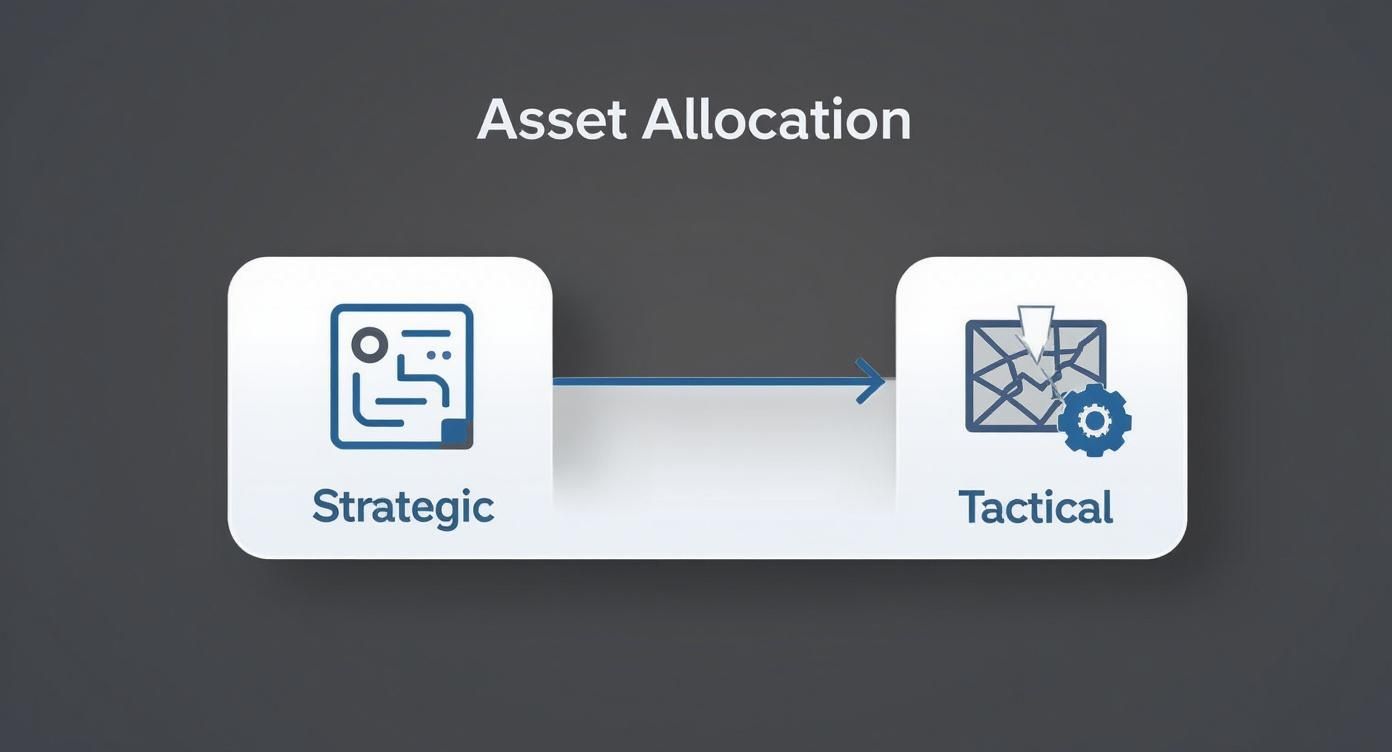
Strategic asset allocation represents the long‑term blueprint of a portfolio based on objectives, risk tolerance, and time horizon. Tactical allocation, by contrast, introduces short‑to‑medium‑term adjustments informed by research and market data.
Key distinctions include:
Time Horizon: Strategic decisions operate on a multi‑year basis; tactical decisions occur over months or quarters.
Activity Level: Strategic allocations change infrequently; tactical adjustments are more active.
Objective: Strategic allocation focuses on long‑term consistency. Tactical allocation seeks to adapt to current conditions while remaining within predetermined risk boundaries.
These two approaches are complementary. The strategic allocation offers stability, while the tactical layer provides adaptability.
How Tactical Adjustments Are Made
Tactical asset allocation is generally implemented through a structured framework. Adjustments are made only when multiple indicators support a temporary shift. These indicators may include valuations, macroeconomic data, earnings trends, or relative performance analysis.
Common implementation considerations include:
Defined Ranges: Tactical shifts often stay within a narrow band around the long‑term target, such as ±5%.
Research‑Driven Decisions: Adjustments are typically supported by quantitative and qualitative analysis.
Attention to Costs: Increased trading frequency may introduce transaction costs and tax considerations.
Ongoing Review: Tactical positions are monitored regularly to assess whether conditions continue to support the adjustment.
Practical Applications
Tactical adjustments can reflect economic or market developments. For example, a portfolio may modestly increase equity exposure during periods of economic expansion or reduce exposure to cyclical sectors during signs of slowdown. Bond allocations may shift in response to interest‑rate changes or yield‑curve movements.
The intent is not to replace long‑term discipline with short‑term forecasting, but rather to incorporate a measured level of adaptability into the portfolio.
Benefits and Risks
Tactical allocation offers potential benefits such as increased flexibility and the opportunity to manage risk during periods of meaningful change. However, it also carries risks, including the possibility that adjustments may not produce the intended outcome or may incur additional costs.
A disciplined process helps ensure that tactical movements remain aligned with long‑term goals and do not become reactive responses to short‑term volatility.

Conclusion
Tactical asset allocation is best understood as an incremental enhancement to a strategic plan, not a replacement for it. When implemented with clear guidelines, research‑driven decision‑making, and attention to costs, it can add flexibility to an investment plan while maintaining a long‑term perspective.
Investment advice offered through Stratos Wealth Partners, Ltd., a registered investment advisor. Stratos Wealth Partners, Ltd and Parkview Partners Capital Management are separate entities. Neither Stratos nor Parkview Partners Capital Management provides legal or tax advice. Please consult legal or tax professionals for specific information regarding your individual situation. Investing involves risk, including possible loss of principal. The information presented is for educational purposes only and should not be interpreted as individualized investment, tax, or legal advice. Past performance is not indicative of future results. For more information, please review our Form ADV, available upon request.
Frequently Asked Questions
Here are a few of the most common questions we hear about tactical asset allocation.
What Is the Main Goal of Tactical Asset Allocation?
At its core, the goal is often to enhance risk-adjusted returns over the short-to-medium term. It is less about trying to perfectly time the market—which is nearly impossible—and more about tilting the odds in one's favor.
This may be done by making deliberate, temporary shifts away from a long-term strategic plan. The idea is to take advantage of market opportunities or manage potential risks as they arise.
How Often Are Tactical Changes Made?
There is no set schedule. This is not like quarterly rebalancing. Tactical shifts are about opportunity and are often driven by research and data.
A manager might make a handful of adjustments during a volatile year, or they might not make any changes at all if the market is quiet. It all comes down to what the market is doing, not what the calendar says.
Is Tactical Asset Allocation a High-Risk Strategy?
Not necessarily. Because it's an active strategy, there's always the risk of getting the timing wrong. That said, a major part of this approach is often about managing risk, not just chasing returns.
For example, a classic tactical move is to reduce exposure to stocks and move more into stable assets like bonds when there is a lot of uncertainty on the horizon. The actual risk level really depends on how large the tactical shifts are and what assets are involved. When it's done within a disciplined framework, it can be a useful tool for managing a portfolio.



Comments