

Navigating the Tax Implications of Selling a Business
Understanding the Tax Complexity of a Business Sale
Selling a business is often one of the most significant financial events an owner may experience. In addition to negotiating price and terms, understanding how taxes may apply to the transaction is an important part of planning. Tax treatment can vary widely depending on how the sale is structured, the nature of the business assets, and individual circumstances.
This guide provides a high-level educational overview of common tax considerations associated with selling a business.
Asset Sales vs. Ownership Interest Sales
One of the most impactful tax distinctions in a business transaction is whether the sale is structured as an asset sale or a sale of ownership interests (such as stock or membership units).
Asset Sale
In an asset sale, individual business assets are sold separately. Each asset category may be taxed differently.
Common asset categories include:
Inventory (often taxed as ordinary income)
Equipment and machinery
Real estate
Intangible assets such as goodwill
Because of this segmentation, asset sales can result in a mix of ordinary income and capital gains tax treatment.
Sale of Ownership Interests
In a stock or membership interest sale, the owner transfers equity rather than individual assets. Gains from these transactions are more commonly taxed as capital gains, depending on holding period and entity type.
The chosen structure often reflects negotiations between buyers and sellers, each with different tax preferences.
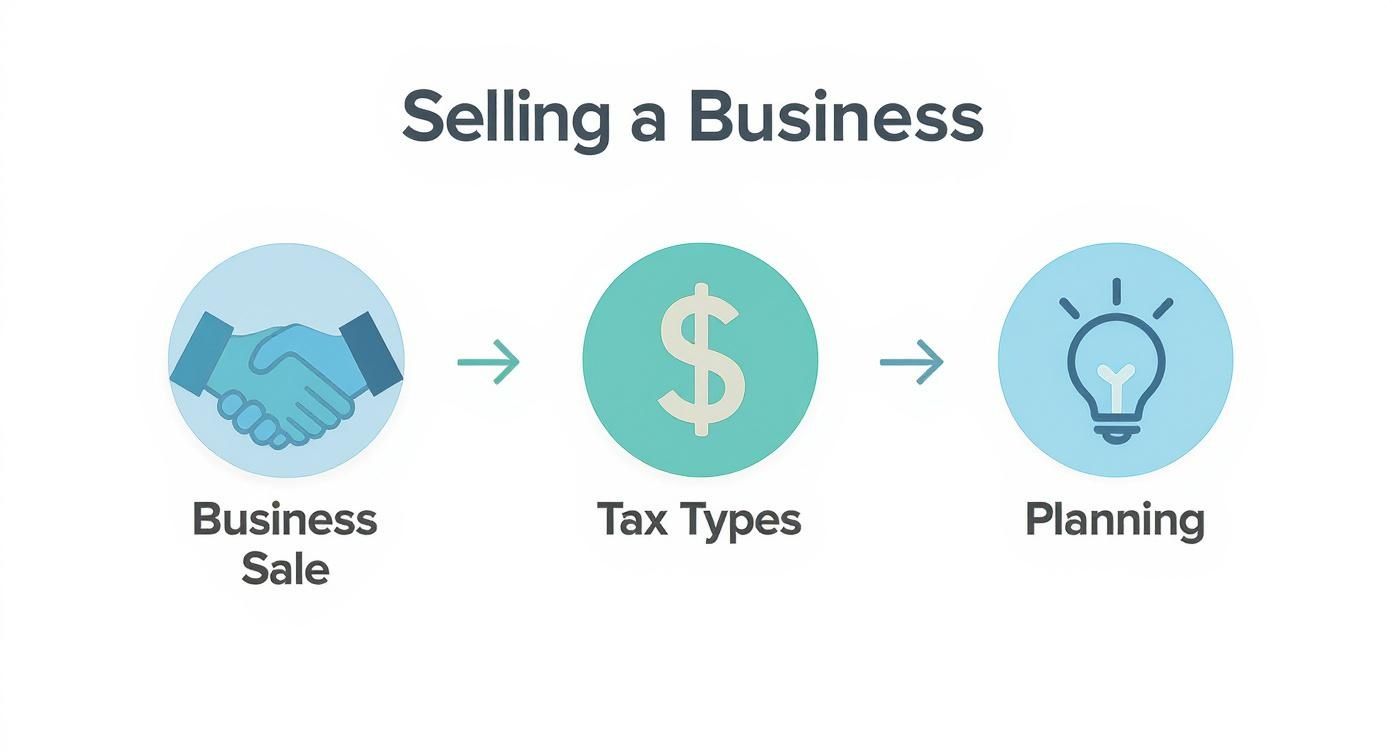
Capital Gains and Ordinary Income Considerations
Capital gains tax generally applies when a business interest or qualifying asset is sold for more than its adjusted basis. The applicable tax rate may depend on whether the gain is classified as short-term or long-term.
Some portions of a sale, however, may be taxed as ordinary income. These can include:
Depreciation recapture
Inventory sales
Certain compensation-related elements
Understanding how proceeds are categorized is critical for estimating after-tax outcomes.
Allocation of the Purchase Price
In asset sales, the total purchase price must be allocated among asset categories using IRS guidelines. This allocation is typically reported on IRS Form 8594.
Allocation decisions influence:
The seller’s tax liability
The buyer’s depreciation and amortization deductions
Because allocation affects both parties, it is often a negotiated component of the transaction.
State and Local Tax Factors
In addition to federal taxes, state and local tax rules may apply to business sale proceeds. Factors such as residency, business location, and state-specific tax laws can affect total tax exposure.
For businesses operating in multiple states, tax treatment may be further complicated by apportionment rules.
Installment Sales
An installment sale allows a seller to receive payments over time rather than in a single lump sum. Capital gains may be recognized proportionally as payments are received.
Considerations Include:
Timing of income recognition
Interest income treatment
Buyer credit risk
Impact on cash flow and planning objectives
Installment sales involve legal and financial complexities that require careful coordination.
Business Sale and Broader Planning
A business sale often intersects with other planning areas, including:
Retirement income planning
Estate and legacy planning
Charitable strategies
Investment portfolio design following a liquidity event
Coordinating tax considerations with these broader objectives may help support long-term planning alignment.
The Importance of Early Planning
Tax planning for a business sale is most effective when addressed well in advance of a transaction. Early planning may provide flexibility in structuring the sale and identifying strategies aligned with long-term goals.
Collaboration among tax professionals, legal advisors, and financial planners is often essential throughout the process.
Conclusion
The tax implications of selling a business depend on many variables, including sale structure, asset classification, and individual financial circumstances. Understanding these factors can help business owners prepare for the financial impact of a transaction and engage in more informed planning discussions.
Because of the complexity involved, professional guidance is an important part of navigating a business sale.
Investment advice offered through Stratos Wealth Partners, Ltd., a registered investment advisor. Stratos Wealth Partners, Ltd and Parkview Partners Capital Management are separate entities. Neither Stratos nor Parkview Partners Capital Management provides legal or tax advice. Please consult legal or tax professionals for specific information regarding your individual situation. Investing involves risk, including possible loss of principal. The information presented is for educational purposes only and should not be interpreted as individualized investment, tax, or legal advice. Past performance is not indicative of future results. For more information, please review our Form ADV, available upon request.


Comments