

How to Mitigate Probate: Strategies That Seek to Protect Your Estate
Understanding the Probate Process
Probate is the legal process through which a deceased person’s assets are administered and distributed under court supervision. This process is designed to validate a will, settle debts, and transfer assets to beneficiaries. While probate serves an important legal function, it can involve time, administrative complexity, and public disclosure.
Estate planning strategies that address probate are often focused on improving efficiency, maintaining privacy, and supporting orderly asset transfer. This guide provides an educational overview of commonly used approaches.

Why Some Individuals Seek to Avoid Probate
Probate experiences vary by state, estate size, and asset structure. Some individuals choose to plan around probate for reasons such as:
Reducing administrative delays
Limiting court involvement
Maintaining privacy of financial affairs
Providing continuity in asset management
Simplifying the transfer process for heirs
Avoiding probate is not always necessary or appropriate, but understanding available tools helps inform planning decisions.
Revocable Living Trusts
A revocable living trust is one of the most commonly used tools for probate avoidance.
How It Works
Assets are transferred into a trust during the grantor’s lifetime. Upon death, a successor trustee manages and distributes trust assets according to the trust terms without court involvement.
Considerations
The trust must be properly funded to be effective
Assets held outside the trust may still require probate
Revocable trusts do not remove assets from the taxable estate

Beneficiary Designations
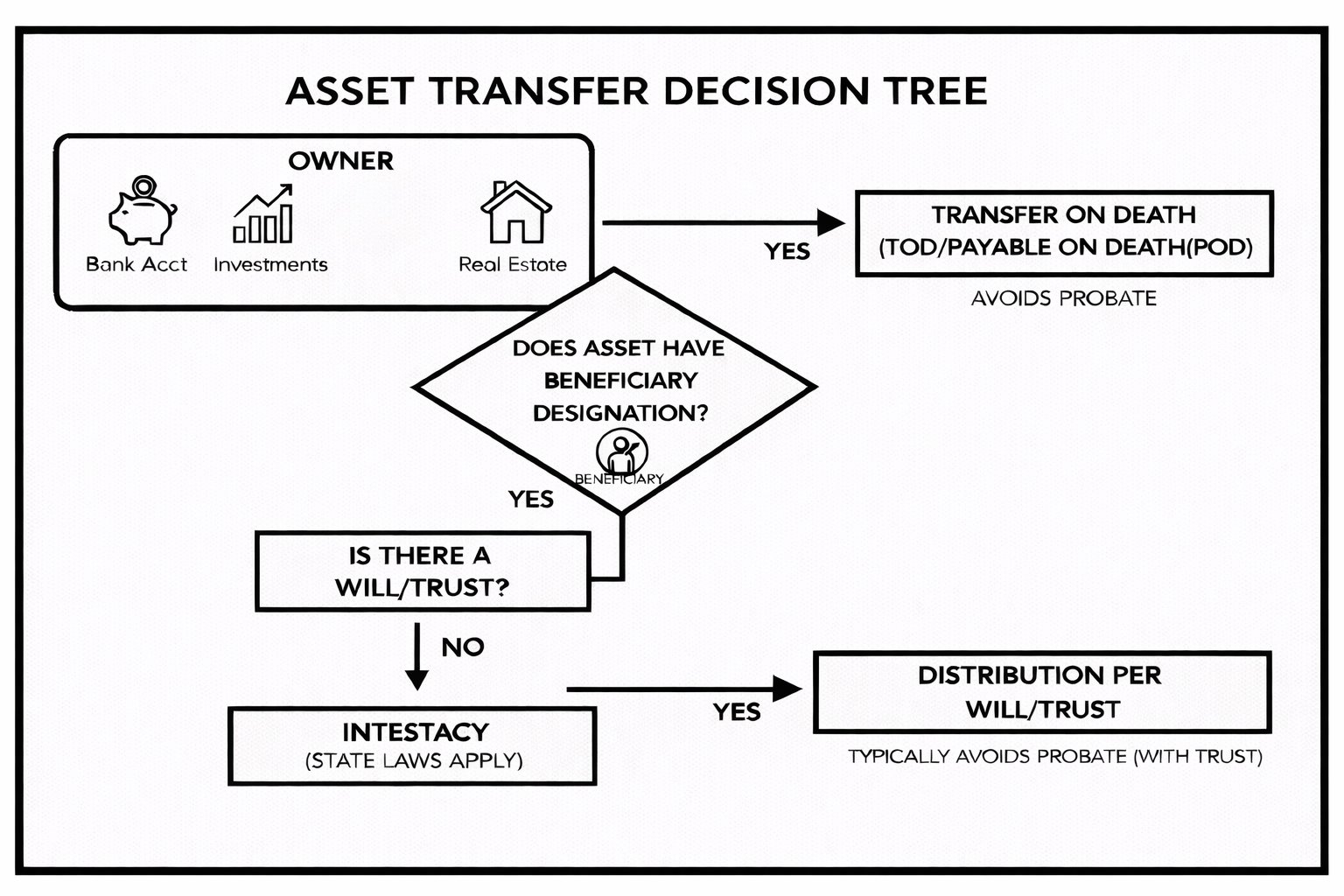
Certain assets pass directly to named beneficiaries and typically bypass probate.
Common Examples
Retirement accounts
Life insurance policies
Payable-on-death (POD) bank accounts
Transfer-on-death (TOD) investment accounts
Keeping beneficiary designations current is essential to ensure alignment with overall estate plans.
Joint Ownership Structures
Joint ownership may allow assets to pass automatically to a surviving owner, depending on how title is held.
Common Forms
Joint tenancy with right of survivorship
Tenancy by the entirety (available in some states)
While joint ownership can avoid probate, it may introduce other considerations, such as creditor exposure or unintended ownership transfers.
Gifting During Lifetime
Lifetime gifting reduces the size of the probate estate by transferring assets before death.
Key Considerations
Gift tax rules and annual exclusion limits
Loss of control over gifted assets
Impact on long-term financial security
Gifting strategies should be coordinated carefully within broader planning objectives.
Use of Trusts Beyond Revocable Trusts
In some cases, irrevocable trusts may also be used to remove assets from the probate process while supporting additional planning goals such as asset protection or estate tax planning.
Irrevocable trusts involve greater complexity and reduced flexibility compared to revocable trusts.
Small Estate Procedures
Some states offer simplified probate procedures for estates below certain value thresholds. These processes may reduce administrative burden but vary significantly by jurisdiction.
Understanding state-specific rules is important when evaluating planning options.
The Importance of Coordination
Probate avoidance strategies are most effective when coordinated across the entire estate plan.
This coordination often includes:
Wills and trusts
Beneficiary designations
Asset titling
Tax planning considerations
Inconsistent or incomplete planning may reduce the effectiveness of probate avoidance efforts.

When Probate May Still Be Appropriate
In some situations, probate may be straightforward or unavoidable. For example:
Assets not properly titled or designated
Disputes among heirs
Complex creditor issues
Understanding when probate applies helps set realistic expectations.
Conclusion
Avoiding probate is a common estate planning objective, but it requires thoughtful coordination and proper implementation. Tools such as trusts, beneficiary designations, and asset titling may help streamline asset transfer and reduce administrative complexity.
Evaluating these strategies within the context of individual circumstances and state law supports informed estate planning decisions.
Investment advice offered through Stratos Wealth Partners, Ltd., a registered investment advisor. Stratos Wealth Partners, Ltd and Parkview Partners Capital Management are separate entities. Neither Stratos nor Parkview Partners Capital Management provides legal or tax advice. Please consult legal or tax professionals for specific information regarding your individual situation. Investing involves risk, including possible loss of principal. The information presented is for educational purposes only and should not be interpreted as individualized investment, tax, or legal advice. Past performance is not indicative of future results. For more information, please review our Form ADV, available upon request.


Comments