top of page

Capital Gains vs Ordinary Income: Tax Planning Strategies

  • 3 days ago
  • 3 min read

Understanding Capital Gains and Ordinary Income


Capital gains and ordinary income are taxed differently under U.S. tax law, and understanding the distinction is an important part of long-term financial planning. The way income is classified can influence overall tax liability and after-tax outcomes.


This guide provides an educational overview of how capital gains and ordinary income are defined, how they are taxed, and common planning considerations associated with each category.


What Is Ordinary Income?


Ordinary income generally includes compensation and earnings received through regular activities.


Common sources include:


  • Wages and salaries

  • Bonuses and commissions

  • Interest income

  • Short-term investment gains

  • Retirement account distributions from traditional IRAs or 401(k)s


Ordinary income is typically taxed at progressive marginal tax rates based on income level.
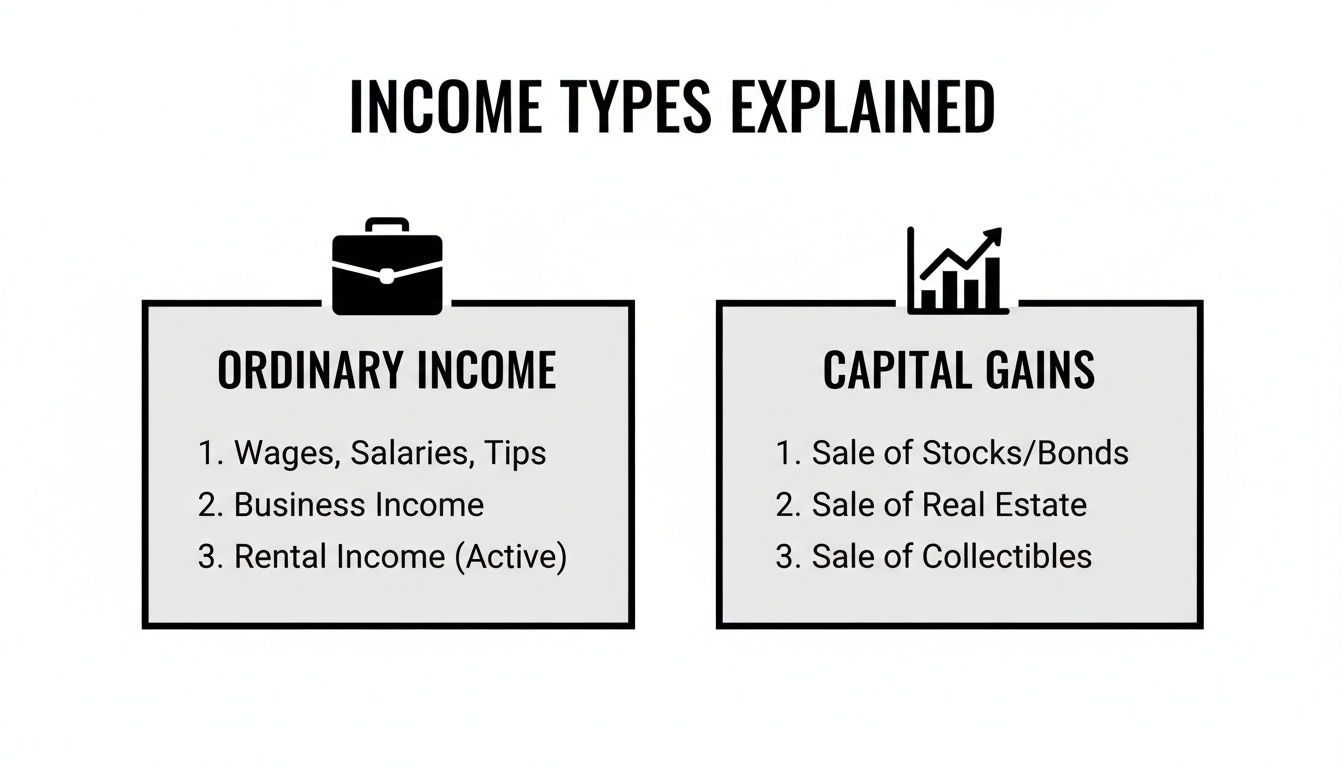

A clear diagram explaining ordinary income and capital gains with their respective examples.


What Are Capital Gains?


Capital gains arise when an asset is sold for more than its purchase price (adjusted basis).


Short-Term Capital Gains


  • Apply to assets held for one year or less

  • Generally taxed at ordinary income tax rates


Long-Term Capital Gains


  • Apply to assets held for more than one year

  • Generally taxed at preferential rates under current law


Holding period plays a central role in determining tax treatment.


Why the Distinction Matters


The difference between capital gains and ordinary income can meaningfully affect after-tax results. Long-term capital gains rates are often lower than ordinary income tax rates, which may influence decisions around investment timing, asset location, and withdrawal strategies.


Tax planning typically focuses on managing the character of income in addition to the amount.


A scale showing a stack of money labeled 'Bonus' with an empty pan, and text 'AFTER-TAX IMPACT'.


Timing Considerations


Timing can influence whether income is taxed as ordinary income or capital gains.


Examples include:


  • Delaying the sale of appreciated assets to qualify for long-term capital gains treatment

  • Spreading income or gains across tax years

  • Coordinating sales with years of lower taxable income


Timing strategies must be evaluated within the context of cash-flow needs and market considerations.


Asset Location and Tax Character


Where assets are held can affect how income is taxed.


  • Taxable accounts: Capital gains are generally recognized when assets are sold

  • Tax-deferred accounts: Withdrawals are typically taxed as ordinary income

  • Tax-free accounts: Qualified withdrawals may not be taxed


Strategic asset location may help align tax treatment with long-term objectives.


Tax-Loss Harvesting


Tax-loss harvesting involves realizing investment losses to offset capital gains.


Key points include:


  • Capital losses may offset capital gains dollar-for-dollar

  • Excess losses may offset a limited amount of ordinary income

  • Unused losses may be carried forward


Tax-loss harvesting is subject to IRS rules and timing restrictions.


A sign with 'TAX-EFFICIENT STRATEGIES' above a desk with coins, an envelope, and a plant.


Retirement Planning Considerations


During retirement, withdrawals from different account types may be taxed differently.


Planning considerations often include:


  • Coordinating withdrawals across account types

  • Managing taxable income to remain within certain tax brackets

  • Evaluating the impact of withdrawals on capital gains taxation


Distribution strategy plays an important role in overall tax efficiency.


State and Local Tax Considerations


In addition to federal taxes, state and local tax rules may apply differently to capital gains and ordinary income. Some states tax both at the same rate, while others offer preferential treatment.


Understanding jurisdiction-specific rules adds clarity to planning decisions.


Integrating Tax Planning Into a Broader Strategy


Tax planning is most effective when integrated with:


  • Investment strategy

  • Retirement income planning

  • Estate and legacy planning

  • Charitable giving strategies


Coordination across these areas helps ensure tax considerations support broader financial goals.


Conclusion


Understanding the difference between capital gains and ordinary income is a foundational element of tax-aware financial planning. By considering income character, timing, and account structure, individuals can make more informed decisions that support long-term objectives.


Because tax laws are complex and subject to change, professional guidance is often an important part of evaluating tax planning strategies.


Investment advice offered through Stratos Wealth Partners, Ltd., a registered investment advisor. Stratos Wealth Partners, Ltd and Parkview Partners Capital Management are separate entities. Neither Stratos nor Parkview Partners Capital Management provides legal or tax advice. Please consult legal or tax professionals for specific information regarding your individual situation. Investing involves risk, including possible loss of principal. The information presented is for educational purposes only and should not be interpreted as individualized investment, tax, or legal advice. Past performance is not indicative of future results. For more information, please review our Form ADV, available upon request.





Comments


Financial Advisor, Investment Advisor, High Net Worth, Wealth Management, Tax Planning, Risk Management, Financial Coordination, Retirement Planning, Charitable Giving, Columbus Ohio, Parkview Partners Capital Management

291 East Livingston Ave.
Columbus, OH 43215


Phone: (614) 427-2132

Fax: (614) 427-2132

  • LinkedIn

FORM CRS


Privacy Policy

Investment advisory services are offered through Stratos Wealth Partners, Ltd., a Registered Investment Advisor located in Beachwood, Ohio. [www.stratoswealthpartners.com]. 

Parkview Partners Capital Management offers its financial services through Stratos Wealth Partners, Ltd., (“Stratos”), a Registered Investment Advisor with the U.S. Securities and Exchange Commission (the “SEC”) located in Beachwood, Ohio. Parkview Partners Capital Management  operates as a DBA branch of Stratos Wealth Partners, Ltd. More information regarding Stratos may be found at www.stratoswealthpartners.com. Registration with the SEC does not imply a certain level of skill or training. Public information concerning Stratos Wealth Partners is available at https://www.adviserinfo.sec.gov. A copy of the Stratos’ current written disclosure Brochure discussing our advisory services and fees continues to remain available upon request and/or on this web site at www.stratoswealthpartners.com.

Stratos may only transact business in those states in which it is registered or qualifies for an exemption or exclusion from registration requirements. Stratos’ web site is limited to the dissemination of general information pertaining to its advisory services, together with access to additional investment-related information, publications, and links. Accordingly, the publication of Stratos’s web site on the Internet should not be construed by any consumer and/or prospective client as Stratos’ solicitation to effect, or attempt to effect transactions in securities, or the rendering of personalized investment advice for compensation, over the Internet. Any subsequent, direct communication by Stratos with a prospective client shall be conducted by a representative that is either registered or qualifies for an exemption or exclusion from registration in the state where the prospective client resides. A copy of Stratos’ current written disclosure Brochure discussing Stratos business operations, services, and fees is available from Stratos upon written request. Stratos does not make any representations or warranties as to the accuracy, timeliness, suitability, completeness, or relevance of any information prepared by any unaffiliated third-party, whether linked to Stratos’ web site or incorporated herein, and takes no responsibility therefore. All such information is provided solely for convenience purposes only and all users thereof should be guided accordingly.
 
Information presented on this site is for informational purposes only and does not intend to make an offer or solicitation for the sale or purchase of any product or security. Investments involve risk and unless otherwise stated, are not guaranteed. Be sure to first consult with a qualified financial advisor and/or tax professional before implementing any strategy discussed here. When you link to any of the websites provided here, you are leaving this website. The information and opinions contained in any of the material requested from this website are provided by third-parties as well. They are for informational purposes only and are not a solicitation to buy or sell any product mentioned. We make no representation as to the completeness or accuracy of the information provided by these third-party websites or third- party materials.


Please remember that different types of investments involve varying degrees of risk, and there can be no assurance that the future performance of any specific investment or investment strategy (including those undertaken or recommended by Stratos Wealth Partners, LTD), will be profitable or equal any historical performance level(s).
 
Certain portions of Stratos’ web site (i.e. newsletters, articles, commentaries, etc.) may contain a discussion of, and/or provide access to, Stratos (and those of other investment and non-investment professionals) positions and/or recommendations as of a specific prior date. Due to various factors, including changing market conditions, such discussion may no longer be reflective of current position(s) and/or recommendation(s). Moreover, no client or prospective client should assume that any such discussion serves as the receipt of, or a substitute for, personalized advice from Stratos, or from any other investment professional. Stratos Wealth Partners, LTD is neither an attorney nor an accountant, and no portion of the web site content should be interpreted as legal, accounting or tax advice.

Each client and prospective client agree, as a condition precedent to his/her/its access to Stratos’ web site, to release and hold harmless Stratos, its officers, directors, owners, employees and agents from any and all adverse consequences resulting from any of his/her/its actions and/or omissions which are independent of his/her/its receipt of personalized individual advice from Stratos.

bottom of page