

An Educational Guide to Modern Portfolio Theory
Understanding the Foundations of Modern Portfolio Theory
Modern Portfolio Theory (MPT) is an investment framework developed to help investors understand how diversification may influence risk and return within a portfolio. Introduced by economist Harry Markowitz in the 1950s, MPT emphasizes that portfolio construction should focus on the collective behavior of assets rather than evaluating investments in isolation.
The central premise of MPT is that combining assets with different risk and return characteristics may help manage overall portfolio volatility while pursuing long-term objectives.
Risk and Return in a Portfolio Context
In MPT, risk is commonly measured by the variability of returns, often expressed as standard deviation. Rather than attempting to eliminate risk entirely, MPT seeks to manage it by balancing exposure across multiple assets.
Key concepts include:
Expected return: The anticipated long-term average return of an investment
Volatility: The degree to which returns fluctuate over time
Portfolio risk: The combined volatility of all assets held together
MPT highlights that portfolio risk is not simply the average risk of individual holdings.

The Role of Diversification
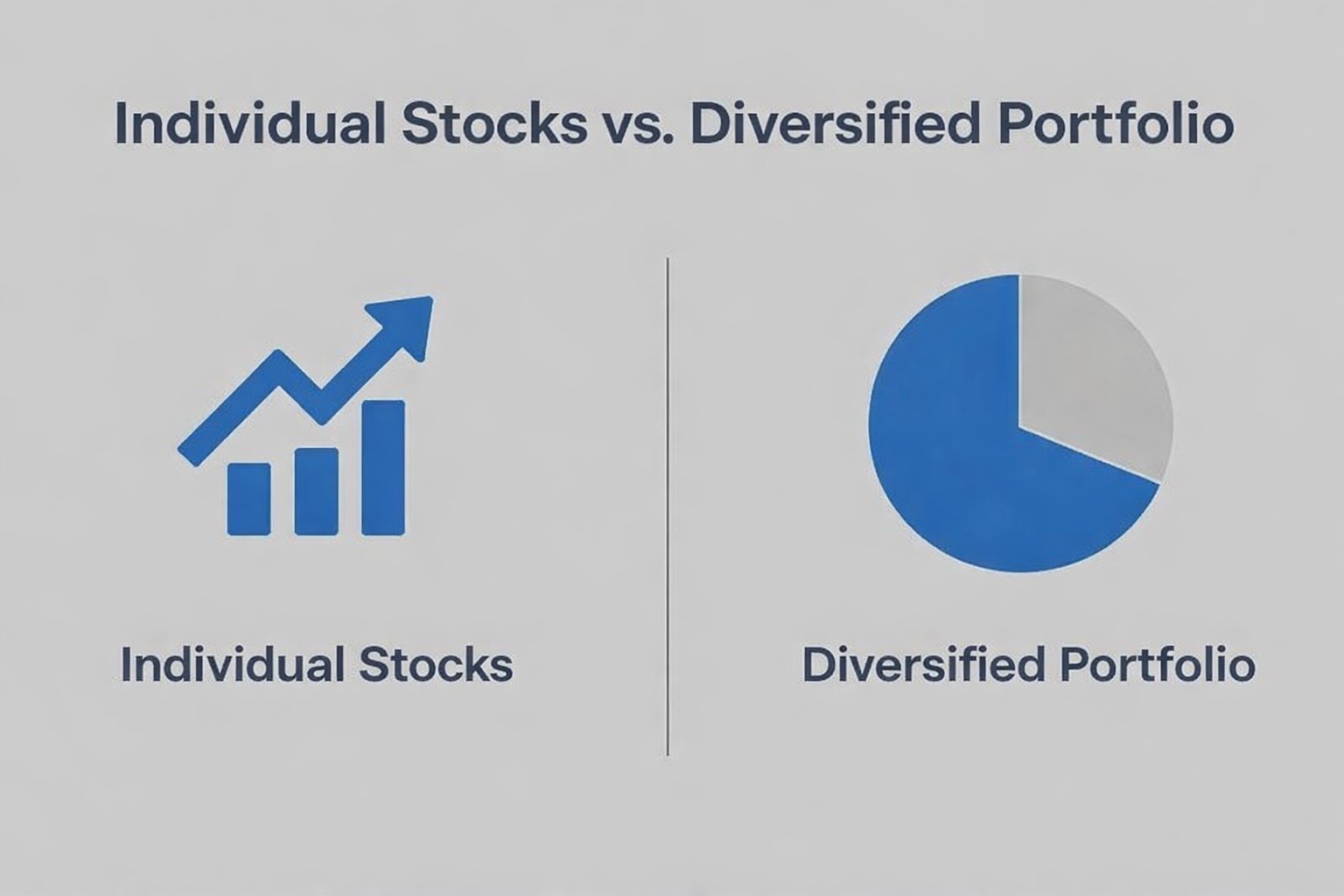
Diversification is a core principle of Modern Portfolio Theory. By combining assets that do not move in perfect alignment, a portfolio may experience reduced volatility compared to holding a single investment.
Correlation and Asset Interaction
Correlation measures how assets move relative to one another:
Positive correlation: Assets tend to move in the same direction
Negative correlation: Assets tend to move in opposite directions
Low correlation: Asset movements are largely independent
MPT suggests that portfolios benefit when assets with low or negative correlations are combined.
The Efficient Frontier
One of the most well-known concepts in MPT is the efficient frontier. This is a theoretical set of portfolios that represent the highest expected return for a given level of risk.
Portfolios that lie below the efficient frontier are considered inefficient because:
They assume more risk without higher expected return, or
They offer lower expected return for the same level of risk
The efficient frontier illustrates trade-offs rather than guarantees.
Asset Allocation as a Strategic Decision
Modern Portfolio Theory places significant importance on asset allocation decisions. The mix of equities, fixed income, and other asset classes often has a greater influence on portfolio behavior than individual security selection.
Asset allocation decisions typically reflect:
Time horizon
Risk tolerance
Income needs
Long-term financial goals
These factors help shape portfolio structure over time.
Assumptions and Limitations of MPT
While influential, Modern Portfolio Theory relies on assumptions that may not always hold in real-world markets.
Common assumptions include:
Investors behave rationally
Markets efficiently price assets
Historical data can inform future expectations
In practice, markets may experience periods where correlations increase, particularly during times of stress. For this reason, MPT is often used as a guiding framework rather than a rigid formula.
MPT in Contemporary Portfolio Construction
Modern Portfolio Theory continues to influence portfolio design, often in combination with additional research and risk-management techniques.
Contemporary applications may include:
Strategic asset allocation models
Risk-based portfolio construction
Factor-based investing considerations
Periodic portfolio rebalancing
MPT principles often serve as a foundation rather than a standalone solution.

Integrating MPT With Long-Term Planning
Modern Portfolio Theory can be more effective when integrated into a broader financial planning process. Portfolio design decisions are often coordinated with tax considerations, income planning, and estate strategies.
Regular reviews help ensure that portfolio assumptions remain aligned with evolving goals and market conditions.
Conclusion
Modern Portfolio Theory provides a structured way to think about diversification, risk, and portfolio construction. By focusing on how assets interact within a portfolio, MPT encourages a long-term, disciplined approach to investing.
While no framework eliminates uncertainty, MPT continues to offer valuable insights when used thoughtfully within a comprehensive financial strategy.
Investment advice offered through Stratos Wealth Partners, Ltd., a registered investment advisor. Stratos Wealth Partners, Ltd and Parkview Partners Capital Management are separate entities. Neither Stratos nor Parkview Partners Capital Management provides legal or tax advice. Please consult legal or tax professionals for specific information regarding your individual situation. Investing involves risk, including possible loss of principal. The information presented is for educational purposes only and should not be interpreted as individualized investment, tax, or legal advice. Past performance is not indicative of future results. For more information, please review our Form ADV, available upon request.


Comments