top of page

Understanding Compound Interest as a Wealth Management Strategy

  • Feb 10
  • 3 min read

What Is Compound Interest?


Compound interest refers to the process by which earnings are generated not only on an original investment but also on accumulated interest over time. As interest is reinvested, future earnings are calculated on a growing base, which can lead to exponential growth over longer periods.


In wealth management, compound interest is often discussed as a foundational concept rather than a tactical strategy. Its effectiveness depends on time horizon, consistency, and the rate of return after expenses and taxes.
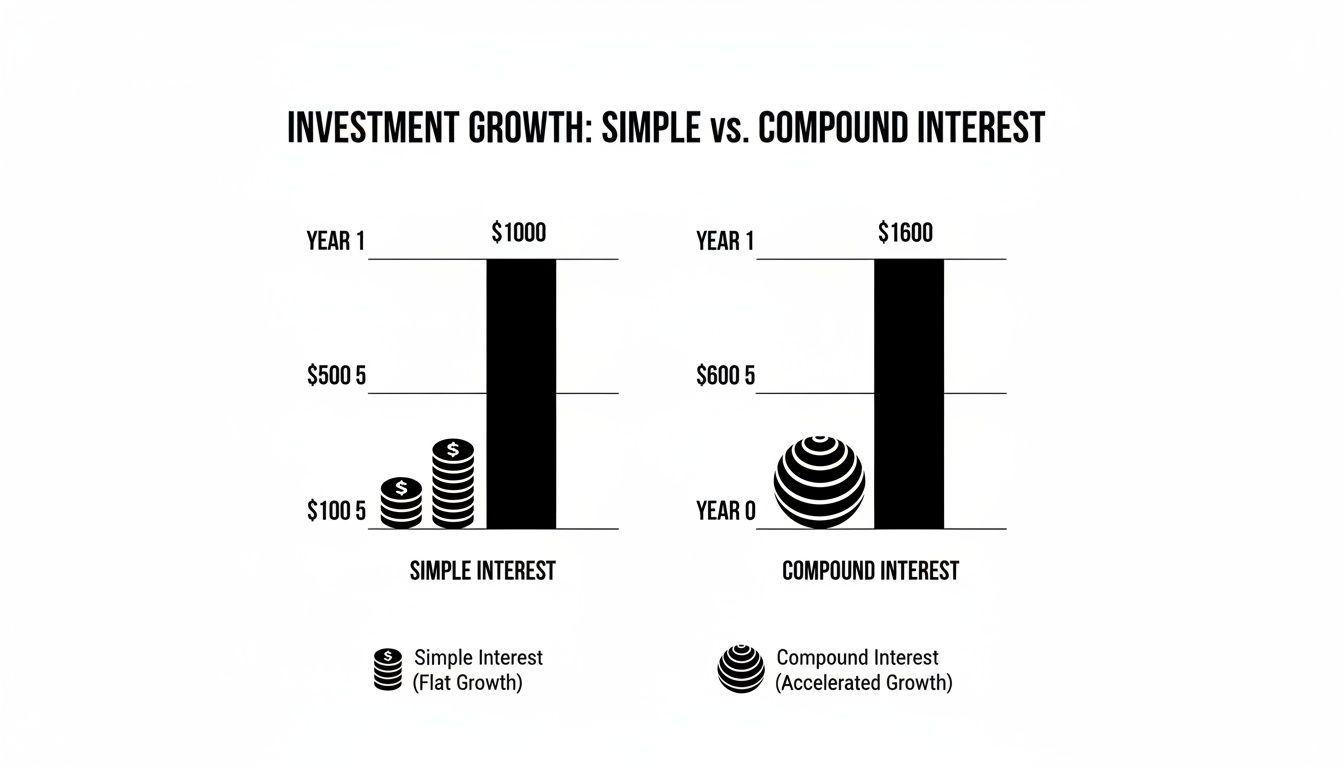

Comparison of investment growth with simple interest (flat growth) versus compound interest (accelerated growth).


How Compounding Works Over Time


Compounding occurs when investment earnings remain invested rather than being withdrawn. Each period’s gains increase the base upon which future returns are calculated.


Two key variables influence compounding outcomes:


  • Time: Longer time horizons generally allow compounding effects to become more pronounced

  • Rate of return: Higher net returns can accelerate wealth accumulation, while lower returns reduce compounding impact


Because compounding builds gradually, its effects may appear modest in early years and more significant later.


The Role of Consistency


Consistency in investing can support the compounding process. Regular contributions, even during periods of market volatility, may help increase the capital base that compounds over time.


This approach emphasizes discipline and long-term perspective rather than attempting to time market movements.


A vibrant green tree stands alone on a sandy field, with a long avenue of bare trees.


Compounding and Investment Costs


Investment expenses and taxes reduce the rate at which assets compound. Since compounding works on net returns, costs such as expense ratios, advisory fees, and transaction expenses can influence long-term outcomes.


Evaluating investment costs in context helps ensure that compounding is not unnecessarily constrained by avoidable expenses.


The Impact of Time Horizon


Time is often considered one of the most important components of compounding. Starting earlier may allow smaller contributions to accumulate meaningfully over decades, while shorter time horizons may limit the effect.


Delaying investment decisions may reduce the opportunity for compounding to work over longer periods.


Compounding Across Different Account Types


The structure of an investment account can influence how compounding occurs.


  • Tax-deferred accounts: Earnings compound without immediate taxation, allowing reinvestment of gains

  • Tax-free accounts: Qualified withdrawals may allow earnings to compound without future tax liability

  • Taxable accounts: Taxes on income or gains may reduce net compounding


Understanding account types helps frame compounding expectations.


A person writing, with a calculator, pie chart, and wooden blocks on a desk, illustrating systematic wealth building.


Behavioral Considerations


Market volatility can challenge the compounding process if it leads to frequent trading or withdrawal of assets during downturns. Emotional decision-making may interrupt long-term compounding by removing assets from the market.


A structured investment plan may help support consistency through market cycles.


Compounding and Real Returns


Inflation affects purchasing power over time. While nominal returns may compound, real returns—returns adjusted for inflation—provide a more meaningful measure of long-term wealth accumulation.


Evaluating real returns helps ensure that compounding contributes to maintaining or increasing purchasing power.


Integrating Compounding Into a Broader Plan


Compound interest works most effectively when integrated into a broader financial strategy that includes goal setting, risk management, tax planning, and ongoing review.


It is not a standalone solution but rather a long-term mathematical effect supported by disciplined planning.


Conclusion


Compound interest is a foundational concept in wealth management that highlights the value of time, consistency, and net returns. While it does not eliminate risk or guarantee outcomes, understanding how compounding works can help individuals make more informed, long-term financial decisions.


Investment advice offered through Stratos Wealth Partners, Ltd., a registered investment advisor. Stratos Wealth Partners, Ltd and Parkview Partners Capital Management are separate entities. Neither Stratos nor Parkview Partners Capital Management provides legal or tax advice. Please consult legal or tax professionals for specific information regarding your individual situation. Investing involves risk, including possible loss of principal. The information presented is for educational purposes only and should not be interpreted as individualized investment, tax, or legal advice. Past performance is not indicative of future results. For more information, please review our Form ADV, available upon request.



Comments


Financial Advisor, Investment Advisor, High Net Worth, Wealth Management, Tax Planning, Risk Management, Financial Coordination, Retirement Planning, Charitable Giving, Columbus Ohio, Parkview Partners Capital Management

291 East Livingston Ave.
Columbus, OH 43215


Phone: (614) 427-2132

Fax: (614) 427-2132

  • LinkedIn

FORM CRS


Privacy Policy

Investment advisory services are offered through Stratos Wealth Partners, Ltd., a Registered Investment Advisor located in Beachwood, Ohio. [www.stratoswealthpartners.com]. 

Parkview Partners Capital Management offers its financial services through Stratos Wealth Partners, Ltd., (“Stratos”), a Registered Investment Advisor with the U.S. Securities and Exchange Commission (the “SEC”) located in Beachwood, Ohio. Parkview Partners Capital Management  operates as a DBA branch of Stratos Wealth Partners, Ltd. More information regarding Stratos may be found at www.stratoswealthpartners.com. Registration with the SEC does not imply a certain level of skill or training. Public information concerning Stratos Wealth Partners is available at https://www.adviserinfo.sec.gov. A copy of the Stratos’ current written disclosure Brochure discussing our advisory services and fees continues to remain available upon request and/or on this web site at www.stratoswealthpartners.com.

Stratos may only transact business in those states in which it is registered or qualifies for an exemption or exclusion from registration requirements. Stratos’ web site is limited to the dissemination of general information pertaining to its advisory services, together with access to additional investment-related information, publications, and links. Accordingly, the publication of Stratos’s web site on the Internet should not be construed by any consumer and/or prospective client as Stratos’ solicitation to effect, or attempt to effect transactions in securities, or the rendering of personalized investment advice for compensation, over the Internet. Any subsequent, direct communication by Stratos with a prospective client shall be conducted by a representative that is either registered or qualifies for an exemption or exclusion from registration in the state where the prospective client resides. A copy of Stratos’ current written disclosure Brochure discussing Stratos business operations, services, and fees is available from Stratos upon written request. Stratos does not make any representations or warranties as to the accuracy, timeliness, suitability, completeness, or relevance of any information prepared by any unaffiliated third-party, whether linked to Stratos’ web site or incorporated herein, and takes no responsibility therefore. All such information is provided solely for convenience purposes only and all users thereof should be guided accordingly.
 
Information presented on this site is for informational purposes only and does not intend to make an offer or solicitation for the sale or purchase of any product or security. Investments involve risk and unless otherwise stated, are not guaranteed. Be sure to first consult with a qualified financial advisor and/or tax professional before implementing any strategy discussed here. When you link to any of the websites provided here, you are leaving this website. The information and opinions contained in any of the material requested from this website are provided by third-parties as well. They are for informational purposes only and are not a solicitation to buy or sell any product mentioned. We make no representation as to the completeness or accuracy of the information provided by these third-party websites or third- party materials.


Please remember that different types of investments involve varying degrees of risk, and there can be no assurance that the future performance of any specific investment or investment strategy (including those undertaken or recommended by Stratos Wealth Partners, LTD), will be profitable or equal any historical performance level(s).
 
Certain portions of Stratos’ web site (i.e. newsletters, articles, commentaries, etc.) may contain a discussion of, and/or provide access to, Stratos (and those of other investment and non-investment professionals) positions and/or recommendations as of a specific prior date. Due to various factors, including changing market conditions, such discussion may no longer be reflective of current position(s) and/or recommendation(s). Moreover, no client or prospective client should assume that any such discussion serves as the receipt of, or a substitute for, personalized advice from Stratos, or from any other investment professional. Stratos Wealth Partners, LTD is neither an attorney nor an accountant, and no portion of the web site content should be interpreted as legal, accounting or tax advice.

Each client and prospective client agree, as a condition precedent to his/her/its access to Stratos’ web site, to release and hold harmless Stratos, its officers, directors, owners, employees and agents from any and all adverse consequences resulting from any of his/her/its actions and/or omissions which are independent of his/her/its receipt of personalized individual advice from Stratos.

bottom of page