

High Net Worth Family Office: Understanding Your Options

How Family Office Services Help Coordinate Complex Wealth
As personal wealth grows, so does financial complexity. Multiple investment accounts, trusts, business interests, real estate holdings, and estate planning strategies often require coordination among several professionals. Without a clear structure, managing these moving parts can become increasingly challenging.
A family office is designed to provide that coordination. Rather than focusing solely on investment management, a family office helps organize the broader financial picture by bringing together investment oversight, tax planning, estate planning, governance, and administrative support.
What Is a Family Office?
A family office is a private wealth management structure that helps oversee the financial affairs of affluent individuals and families.
Depending on a family's needs, services may include:
Investment oversight
Estate planning coordination
Tax planning collaboration
Trust administration
Cash flow reporting
Risk management
Family governance
Philanthropic planning
The goal is to improve communication and coordination among advisors while helping families manage wealth across generations.
Family Office vs. Traditional Wealth Management
While traditional wealth management focuses on investment planning and financial advice, a family office often provides a broader level of coordination.
Traditional Wealth Management | Family Office |
Investment management | Comprehensive wealth coordination |
Financial planning | Investment, tax, estate, and governance oversight |
Individual client relationship | Multi-generational family support |
Portfolio reporting | Consolidated reporting across multiple entities and assets |
For families with increasingly complex financial lives, a family office may help streamline decision-making and improve organization.
Common Family Office Models
Not every family requires the same level of infrastructure. Family offices generally fall into three categories.
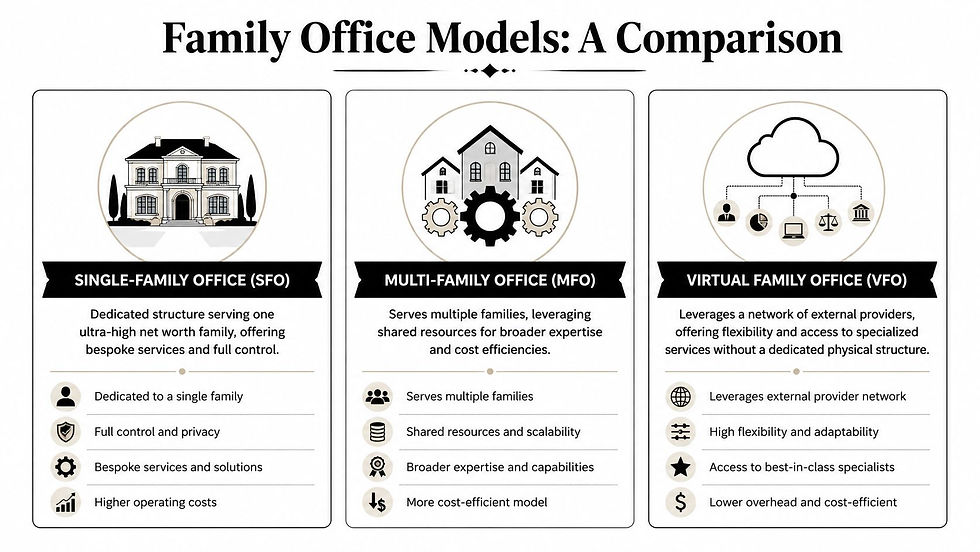
Single-Family Office
A single-family office is dedicated to serving one family. This model offers the highest level of customization and control but typically requires significant financial resources to establish and maintain.
Multi-Family Office
A multi-family office provides similar services while serving multiple families. By sharing infrastructure and professional resources, this model can offer comprehensive support with lower overhead than maintaining a dedicated office.
Virtual Family Office
A virtual family office coordinates a network of outside professionals rather than employing a full in-house staff. Investment advisors, attorneys, accountants, and other specialists work together under a coordinated planning approach.
For many families, this model offers flexibility while reducing administrative complexity.
Services Often Included
Family office services may extend well beyond investment management.
Common areas of support include:
Portfolio oversight
Estate planning coordination
Tax planning collaboration
Trust administration
Business succession planning
Liquidity planning
Family governance
Financial reporting
Philanthropic planning
The objective is to ensure these areas work together as part of a unified long-term strategy.
Governance Matters
As wealth is transferred across generations, governance becomes increasingly important.
A family office may help establish:
Decision-making processes
Family policies
Roles and responsibilities
Communication frameworks
Documentation standards
Clear governance can reduce confusion and help preserve family wealth over time.
Managing Operational Risk
Financial complexity also introduces operational risks that extend beyond investment performance.
Families may benefit from reviewing:
Cybersecurity practices
Payment approval procedures
Vendor oversight
Record management
Data security
Internal controls
Establishing appropriate safeguards may help reduce the risk of fraud, errors, and administrative challenges.
Is a Family Office Right for You?
A family office may be worth considering if your financial life includes multiple interconnected assets or responsibilities, such as:
Significant investment portfolios
Business ownership
Trusts and estate planning structures
Multiple real estate holdings
Charitable foundations
Multi-generational wealth planning
The appropriate structure depends on the complexity of your financial situation, family objectives, and long-term planning needs.
Final Thoughts
A family office is more than an investment management solution. It provides a framework for coordinating the many financial, legal, tax, and administrative responsibilities that often accompany substantial wealth.
Whether through a single-family office, multi-family office, or virtual family office model, the goal remains the same: creating an organized approach to managing wealth while supporting long-term financial objectives across generations. At Parkview Partners Capital Management, we understand the complexities of building a lasting legacy. To discuss how these strategies might apply to your specific situation, contact our team for a personalized consultation.
Compliance Disclosure
Parkview Partners Capital Management is a registered investment adviser. This article is provided for educational and informational purposes only and should not be interpreted as individualized investment, legal, tax, or financial planning advice. Investment strategies involve risk, including the possible loss of principal. Decisions regarding wealth management and family office services should be based on your individual circumstances and made in consultation with qualified professionals. Please review the firm's current disclosure documents for additional information.



Comments