

Economic and Financial Market Update - July 2026
Recent Market News
Following their climb from the late March lows, equity markets have experienced increased volatility in July due to escalating geopolitical tensions, ambiguity over the Fed’s rate path, and momentum shifting away from the AI trade. Amidst this volatility, corporate profits have become the focus of the year, as we will explore in greater detail below.

Early in July, the memorandum of understanding between the U.S. and Iran broke down as Iran began striking targets across Bahrain, Jordan, Kuwait, Oman, and Qatar, prompting ongoing retaliation from U.S. forces and signaling a significant escalation in the war. Oil prices jumped on the news – though not nearly to March/April levels – adding to inflationary fears. Consequently, bond yields have steadily risen, reflecting the odds that the Federal Reserve will hike rates sooner rather than later due to the inflationary impact of rising energy prices.1 In the first meeting led by Fed Chairman Kevin Warsh (July 28-29), the Federal Reserve opted to maintain the current federal funds rate (3.5%-3.75%), reiterating that the committee remains committed to delivering price stability and achieving its 2% inflation target. The statement also noted that economic activity continues to expand at a healthy pace despite geopolitical uncertainty, driven by productivity growth and capital investment. Unlike prior Fed leadership, Chairman Warsh does not wish to provide significant detail or commentary on the Fed’s rate path in hopes that the market will react to economic developments rather than Fed guidance, but implied that the recent rise in yields may have reduced the necessity of a July rate hike.2 Warsh’s comments during the FOMC press conference added to bond market apprehension, as short-term yields fell and long-term yields rose, suggesting that the bond market believes the Fed may not raise rates quickly enough to subdue inflation. Stay tuned.

Though we continue to closely monitor geopolitical events and their impacts on the macro environment, we maintain our stance that consistent economic growth supported by a robust consumer and domestic investment, stability in the labor market, and momentum in corporate earnings underpins a constructive backdrop for equity markets.
Earnings Season So Far
Second quarter results continue to reinforce the resilience of corporate earnings. With 61% of S&P 500 companies having reported results as of July 31st, 86% beat earnings expectations and 77% beat revenue expectations, both above historical averages. This ongoing momentum in earnings improvement has broadened across the market, as 10 of the 11 S&P 500 sectors (all but Health Care) are reporting year-over-year earnings growth. The energy sector has been supported by elevated oil prices; information technology continues to benefit from AI-driven capital expenditures as demand for compute outpaces supply; and financials are buoyed by strong equity markets, resilient consumer spending, and healthy credit conditions.

The Q2 blended earnings growth rate (which combines actual reported results with estimated figures for companies yet to report) for the S&P 500 jumped from 38.0% y/y on July 24th to 47.4% y/y on July 31st, which would be the highest growth rate for the index since the second quarter of 2021 (91.6%). Though this headline number looks remarkable, it is important to note that the reported results of Alphabet and Amazon have meaningfully distorted the figure. The significant increases in earnings growth from June 30th to July 31st for the Communication Services and Consumer Discretionary sectors, shown above, are due to massive unrealized capital gains on investments held by Alphabet and Amazon, respectively. Alphabet recorded a gain of $98.0 billion related to its investments in Anthropic and SpaceX, boosting its earnings per share (EPS) from $2.85 to $9.11. Similarly, Amazon recorded a gain of $53.4 billion related to its investment in Anthropic. Generally Accepted Accounting Principles (GAAP) require companies to report unrealized equity gains and losses on their income statements, resulting in these distorted metrics. Excluding the outsized impact of Alphabet and Amazon, the blended earnings growth rate for the S&P 500 is 28.8%, which would mark the seventh consecutive quarter of double-digit y/y earnings growth and the second consecutive quarter above 20% – still a very strong result.3
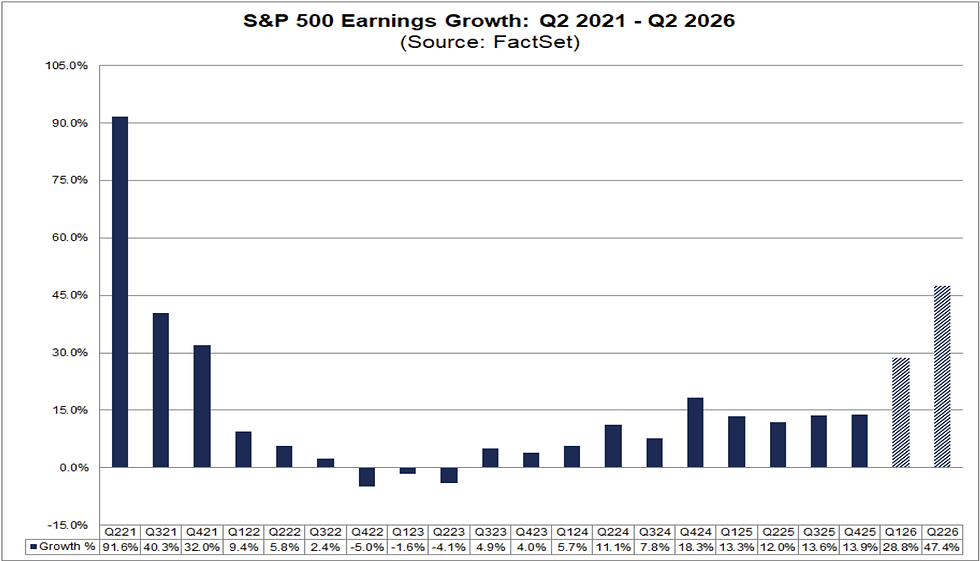
Though the inflated EPS growth of Alphabet and Amazon has skewed quarterly results, it is important to note that the share of S&P 500 companies reporting growth in forward earnings (85.1%) and revenues (87.6%) remains historically strong and continues to demonstrate the breadth of corporate earnings strength.

Market Valuation Dynamics
As we noted in last month’s update, strength in earnings – further inflated by the earnings results described above – has resulted in an interesting valuation dynamic in equity markets. The uncharacteristic boost to forward earnings has reduced the forward price/earnings ratio to 19.3x from over 22x in January, while the forward price/sales ratio – unaffected by the distortion of marked-up unrealized gains – remains near record levels at 3.31x. The Price/Earnings-to-Growth ratio is similarly distorted. Historically, a PEG ratio below 1.0 has typically coincided with a severe market correction due to a weak macroeconomic environment (e.g., Great Recession, COVID pandemic). Today, the PEG ratio is near a record low (0.83) while major equity indices are near all-time-highs, highlighting the positive impact of earnings growth on valuations.4
Despite the inflated earnings contribution from the Communication Services (Alphabet) and Consumer Discretionary (Amazon) sectors, the current market environment differs meaningfully from the dot-com bubble of the late ‘90s. The P/E of the technology sector is 22.1x – only slightly elevated relative to the overall index. At the peak of the bubble in 2000, the spread between technology and the broader market was far greater (see below) because many technology companies at the time were not profitable – a stark contrast to the sector today.5

Our Thoughts
We remain confident in the widespread corporate earnings momentum across sectors and market cap segments that continues to underpin equity market performance. Despite being tested by geopolitical events and inflationary shocks, the latest economic data suggests that the U.S. economy remains remarkably resilient, which should provide additional support to equity prices in the near term. While we acknowledge that elevated inflation remains a concern, we believe the consumer remains well positioned to withstand this headwind. The unemployment rate remains at a historically heathy 4.1%, while weekly initial jobless claims – a forward indicator of employment trends – remains near all-time lows, well below the long-term average.9 Consumer confidence/sentiment metrics remain pessimistic, however, balance sheets are strong, and the household debt service ratio (debt payments as a percentage of disposable income) remains well below levels seen in recent decades.
GDP growth continues to be driven by consumer spending, which rose to 3.2% in Q2 from 0.5% in Q1 while non-residential (i.e., business) investment grew 8.4%. A decline in government spending alongside a large increase in imports related to AI capital expenditures weighed on headline GDP, which came in at 1.5%, down from 2.1% in Q1. Beneath this headline figure, real final sales to domestic purchasers – which excludes the volatile impacts of trade and inventories – accelerated to 3.9%, the strongest since Q1 2023, indicating that underlying economic activity remains robust despite the softer headline result.
As always, we appreciate the opportunity to serve you and highly value our relationship. We look forward to meeting you in the near future and are always available and pleased to assist in the interim.
Disclosures
Securities offered through LPL Financial, Member FINRA/SIPC. Investment advice offered through Stratos Wealth Partners, Ltd., a registered investment advisor. Stratos Wealth Partners, Ltd. and Parkview Partners Capital Management are separate entities from LPL Financial.
The information contained herein has been obtained from sources known to be reliable. However, no guarantee, representation, or warranty, express or implied, is made as to its accuracy, completeness, or correctness.
There is no guarantee a diversified portfolio will enhance overall returns or outperform a non-diversified portfolio.
Diversification and asset allocation do not protect against market risk. International investing involves special risks such as currency fluctuation and political instability and may not be suitable for all investors. Rebalancing a portfolio may cause investors to incur tax liabilities and/or transaction costs and does not assure a profit or protect against a loss.
Bonds are subject to market and interest rate risk if sold prior to maturity. Bond values will decline as interest rates rise and bonds are subject to availability and change in price. Bond yields are subject to change. Certain call or special redemption features may exist which could impact yield.
The opinions voiced in this material are for general information only and not intended to provide specific advice or recommendations for any individual. To determine which investment(s) may be appropriate for you, consult your financial advisor prior to investing. All performance referenced is historical and is no guarantee of future results. Indices are unmanaged and may not be invested into directly. Investing involves risk including loss of principal.
The economic forecasts set forth in this material may not develop as predicted and there can be no guarantee that strategies promoted will be successful.
Stratos Wealth Partners and its affiliates do not provide tax, legal or accounting advice. This material has been prepared for informational purposes only, and is not intended to provide, and should not be relied on for, tax, legal or accounting advice. You should consult your own tax, legal and accounting advisors before engaging in any transaction.

Comments