

Bonds vs Funds: An Investor's Guide to Fixed Income Strategy
When comparing bonds and bond funds, the distinction often comes down to structure, control, and how each fits within a broader portfolio strategy.
An individual bond represents a direct lending relationship, where an investor may receive interest payments and the return of principal at maturity, assuming no default. A bond fund, by contrast, represents ownership in a diversified portfolio of bonds managed collectively, with no fixed maturity date.
Understanding these differences may help investors evaluate how each approach aligns with income needs, risk considerations, and long-term financial objectives.
Key Differences Between Bonds and Bond Funds
At a high level, bonds and bond funds differ in several important ways:
Ownership - Bonds: Direct ownership of a debt instrument - Bond funds: Shares in a pooled investment vehicle
Maturity - Bonds: Defined maturity date - Bond funds: No maturity; ongoing portfolio
Income - Bonds: Typically fixed interest payments - Bond funds: Variable distributions
Diversification - Bonds: May require significant capital to diversify - Bond funds: Provide broad exposure across issuers
These structural differences influence how each behaves under varying market conditions.

How Individual Bonds Function
Individual bonds are designed to provide a defined series of cash flows. Investors typically receive periodic interest payments and, at maturity, repayment of principal, assuming the issuer remains solvent.
Bond pricing can fluctuate based on interest rates and credit quality. However, holding a bond to maturity may reduce the impact of interim price changes on the return of principal.
Credit quality is an important consideration. Bonds issued by entities with lower credit ratings may offer higher yields, reflecting increased uncertainty around repayment.
How Bond Funds Operate
Bond funds pool capital from multiple investors and allocate it across a portfolio of bonds. The value of a bond fund is reflected in its net asset value (NAV), which changes based on market conditions and portfolio holdings.
Unlike individual bonds, bond funds do not mature. Portfolio managers continuously buy and sell securities to maintain the fund’s strategy, which may introduce ongoing exposure to interest rate movements.
Bond funds may provide:
Broad diversification across issuers and sectors
Professional management
Accessibility with lower initial investment requirements
However, their value can fluctuate over time due to changes in interest rates and market conditions.

Risk and Return Considerations
The differences in structure between bonds and bond funds lead to distinct risk characteristics.
Interest Rate Sensitivity
Individual bonds may allow investors to hold until maturity, potentially reducing exposure to interim price volatility
Bond funds remain continuously exposed to interest rate changes, which may impact NAV
Credit Risk
Individual bonds expose investors to issuer-specific risk
Bond funds spread this risk across multiple holdings, which may reduce the impact of any single issuer
Income Stability
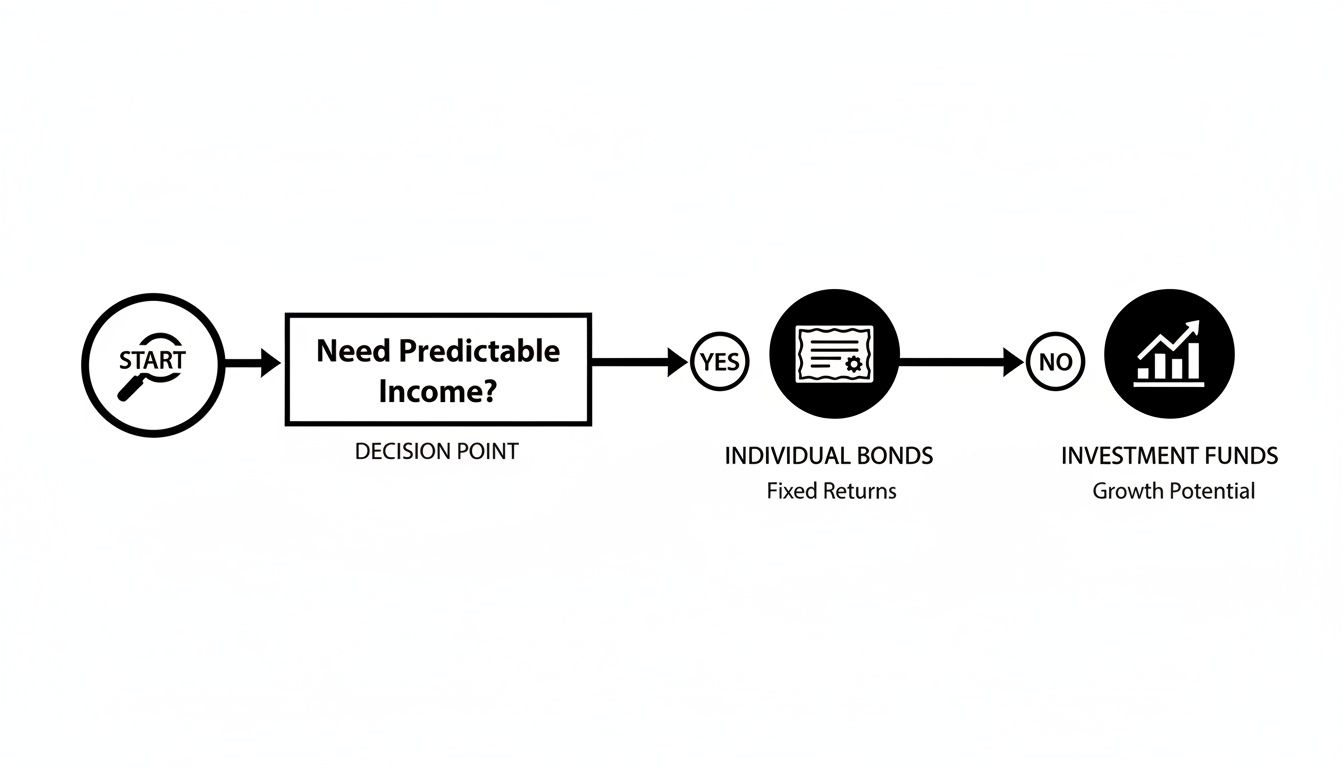
Bonds may provide more predictable income streams
Bond fund distributions may vary based on portfolio activity and market conditions
Each approach involves trade-offs that may be evaluated within the context of a broader portfolio.
Tax, Liquidity, and Cost Considerations
Operational factors may also influence how bonds and bond funds are used.
Tax Considerations
Owning individual bonds may allow for more direct control over capital gains and losses. Bond funds may distribute capital gains generated by portfolio activity, which can create taxable events.
Liquidity
Bond funds, particularly exchange-traded funds (ETFs), are generally more liquid and can be traded throughout the day. Individual bonds may be less liquid, with pricing determined through dealer networks.
Costs
Bond funds typically include an expense ratio
Individual bonds may involve transaction costs, such as bid-ask spreads
Evaluating total costs may provide a clearer picture of each approach.

Portfolio Construction Considerations
There is no single approach that applies universally. Bonds and bond funds may serve different roles depending on an investor’s objectives.
Defined future expenses: Individual bonds with specific maturity dates may align with known liabilities
Broad market exposure: Bond funds may provide diversified access with less complexity
Blended strategies: Some portfolios incorporate both approaches to balance stability and flexibility
The appropriate mix often depends on time horizon, income needs, and overall portfolio structure.
Conclusion
The comparison between bonds and bond funds is not a matter of one being inherently better than the other. Each serves a distinct purpose within a fixed income strategy.
Individual bonds may offer defined cash flows and maturity timelines, while bond funds may provide diversification and ease of access. Evaluating how these tools function within a broader financial plan may help inform a structured and disciplined approach to fixed income investing.
Investment advice offered through Stratos Wealth Partners, Ltd., a registered investment advisor. Stratos Wealth Partners, Ltd. and Parkview Partners Capital Management are separate entities. This material is provided for informational purposes only and should not be considered investment, tax, or legal advice. Individuals should consult their professional advisors regarding their specific circumstances. Past performance is not a guarantee of future results.


Comments