

Advanced Estate Planning Tax Strategies for Long-Term Wealth Planning
Estate planning for high-net-worth individuals often involves evaluating strategies that may help manage tax exposure while supporting long-term financial and legacy objectives.
Advanced estate planning techniques are typically designed to address the transfer of wealth in a structured manner, taking into account current tax laws, family considerations, and broader financial goals.
This article provides an overview of several commonly discussed estate planning tax strategies and considerations.
Understanding Estate Taxes
Estate taxes may apply to the transfer of assets at death, depending on the value of the estate and applicable federal or state thresholds.
Key considerations may include:
Federal estate tax exemption levels
State estate or inheritance taxes, where applicable
Changes in tax law that may affect future planning
Because exemption levels and regulations can change, estate planning strategies are often reviewed periodically.

Gifting Strategies
Gifting is a commonly used approach in estate planning that involves transferring assets during one’s lifetime.
Annual Exclusion Gifts
Individuals may make gifts up to a specified annual limit per recipient without reducing their lifetime exemption.
This approach may allow for gradual transfer of wealth over time.
Lifetime Gifting
Larger gifts may be made using a portion of the lifetime estate and gift tax exemption.
This strategy may reduce the overall size of a taxable estate, depending on individual circumstances and future tax considerations.
Irrevocable Trust Strategies
Irrevocable trusts are often used in advanced estate planning to transfer assets outside of an individual’s taxable estate.
Once assets are transferred into an irrevocable trust, the original owner generally relinquishes control over those assets, subject to the terms of the trust.
Irrevocable Life Insurance Trust (ILIT)
An ILIT is designed to hold life insurance policies outside of the taxable estate.
The proceeds from the policy may provide liquidity to beneficiaries, which can be used for various planning purposes.
Grantor Retained Annuity Trust (GRAT)
A GRAT allows an individual to transfer assets while retaining the right to receive annuity payments for a defined period.
If the assets appreciate beyond a certain threshold, the excess value may pass to beneficiaries, subject to applicable rules.
Spousal Lifetime Access Trust (SLAT)
A SLAT allows one spouse to transfer assets into a trust for the benefit of the other spouse.
This structure may provide indirect access to the assets while potentially removing them from the taxable estate.
Charitable Planning Strategies
Charitable strategies may be incorporated into estate planning to align philanthropic goals with financial planning considerations.
Charitable Remainder Trust (CRT)
A CRT provides income to the donor or beneficiaries for a specified period, with the remaining assets ultimately distributed to a charitable organization.
Charitable Lead Trust (CLT)
A CLT provides income to a charitable organization for a set period, after which the remaining assets may pass to beneficiaries.
Donor-Advised Funds (DAFs)
Donor-advised funds allow individuals to make charitable contributions and recommend grants to charitable organizations over time.
These vehicles may offer flexibility in managing philanthropic giving.
Family Limited Partnerships (FLPs)
Family limited partnerships are sometimes used to transfer business or investment assets to family members in a structured way.
These arrangements may:
Facilitate gradual ownership transfers
Support centralized management of family assets
Provide a framework for long-term succession planning
Valuation Considerations
Valuation plays a critical role in estate planning, particularly when transferring closely held business interests or illiquid assets.
Professional appraisals are often used to determine fair market value and support compliance with tax regulations.
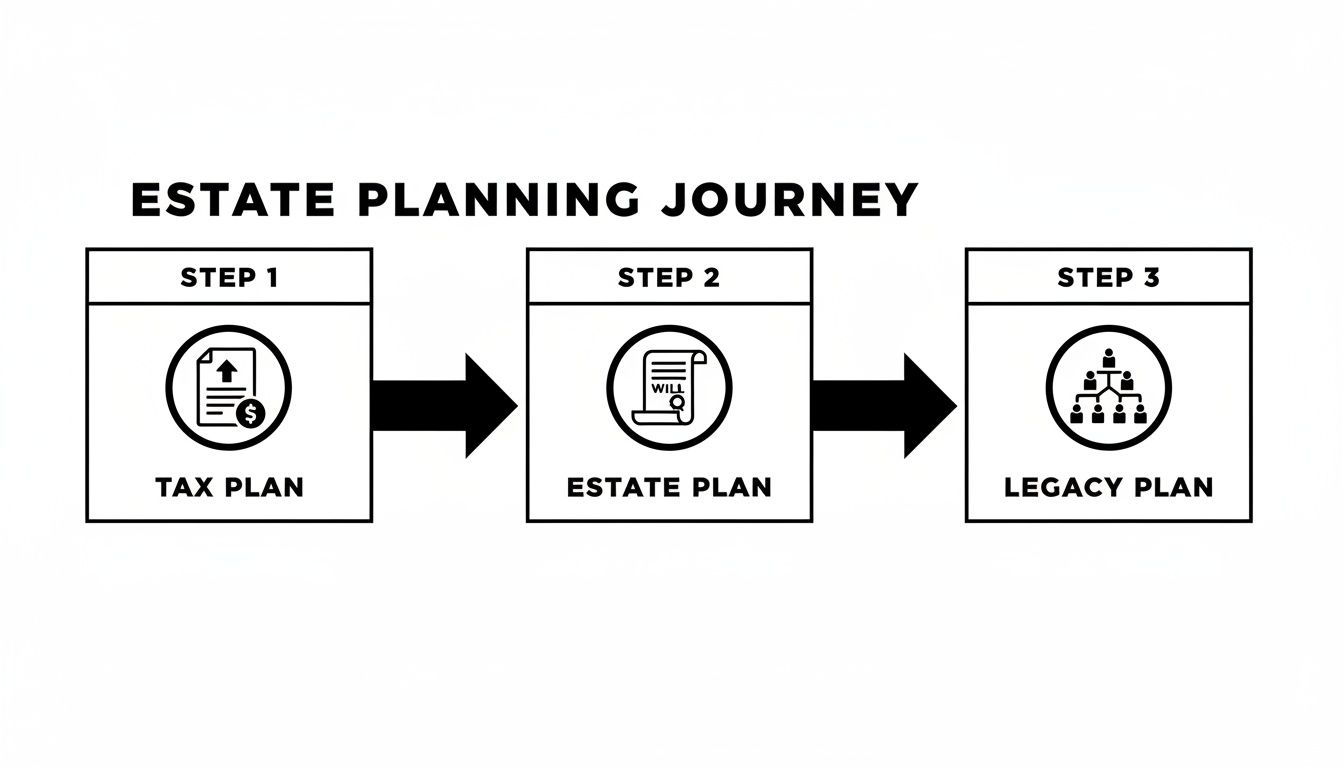
Coordinating Estate Planning With Broader Financial Strategy
Estate planning is often integrated with other areas of financial planning, including:
Investment management
Tax planning
Business succession planning
Retirement planning
Coordinating these elements may help align long-term objectives across multiple areas of financial decision-making.
Reviewing Estate Plans Over Time
Estate plans are typically reviewed periodically to reflect:
Changes in tax laws
Shifts in asset values
Family or business developments
Evolving financial goals
Regular review may help ensure that strategies remain aligned with current circumstances.
Conclusion
Advanced estate planning strategies can provide a structured approach to managing wealth transfer and tax considerations. Because these strategies involve complex legal and tax implications, they are often implemented in coordination with qualified legal, tax, and financial professionals.
Understanding the available tools and how they may apply to individual circumstances can help support more informed planning decisions.
Investment advice offered through Stratos Wealth Partners, Ltd., a registered investment advisor. Stratos Wealth Partners, Ltd. and Parkview Partners Capital Management are separate entities. This material is provided for informational purposes only and should not be considered investment, tax, or legal advice. Individuals should consult their professional advisors regarding their specific circumstances. Past performance is not a guarantee of future results.


Comments